
/**
* REST API: WP_REST_Server class
*
* @package WordPress
* @subpackage REST_API
* @since 4.4.0
*/
/**
* Core class used to implement the WordPress REST API server.
*
* @since 4.4.0
*/
#[AllowDynamicProperties]
class WP_REST_Server {
/**
* Alias for GET transport method.
*
* @since 4.4.0
* @var string
*/
const READABLE = 'GET';
/**
* Alias for POST transport method.
*
* @since 4.4.0
* @var string
*/
const CREATABLE = 'POST';
/**
* Alias for POST, PUT, PATCH transport methods together.
*
* @since 4.4.0
* @var string
*/
const EDITABLE = 'POST, PUT, PATCH';
/**
* Alias for DELETE transport method.
*
* @since 4.4.0
* @var string
*/
const DELETABLE = 'DELETE';
/**
* Alias for GET, POST, PUT, PATCH & DELETE transport methods together.
*
* @since 4.4.0
* @var string
*/
const ALLMETHODS = 'GET, POST, PUT, PATCH, DELETE';
/**
* Namespaces registered to the server.
*
* @since 4.4.0
* @var array
*/
protected $namespaces = array();
/**
* Endpoints registered to the server.
*
* @since 4.4.0
* @var array
*/
protected $endpoints = array();
/**
* Options defined for the routes.
*
* @since 4.4.0
* @var array
*/
protected $route_options = array();
/**
* Caches embedded requests.
*
* @since 5.4.0
* @var array
*/
protected $embed_cache = array();
/**
* Stores request objects that are currently being handled.
*
* @since 6.5.0
* @var array
*/
protected $dispatching_requests = array();
/**
* Instantiates the REST server.
*
* @since 4.4.0
*/
public function __construct() {
$this->endpoints = array(
// Meta endpoints.
'/' => array(
'callback' => array( $this, 'get_index' ),
'methods' => 'GET',
'args' => array(
'context' => array(
'default' => 'view',
),
),
),
'/batch/v1' => array(
'callback' => array( $this, 'serve_batch_request_v1' ),
'methods' => 'POST',
'args' => array(
'validation' => array(
'type' => 'string',
'enum' => array( 'require-all-validate', 'normal' ),
'default' => 'normal',
),
'requests' => array(
'required' => true,
'type' => 'array',
'maxItems' => $this->get_max_batch_size(),
'items' => array(
'type' => 'object',
'properties' => array(
'method' => array(
'type' => 'string',
'enum' => array( 'POST', 'PUT', 'PATCH', 'DELETE' ),
'default' => 'POST',
),
'path' => array(
'type' => 'string',
'required' => true,
),
'body' => array(
'type' => 'object',
'properties' => array(),
'additionalProperties' => true,
),
'headers' => array(
'type' => 'object',
'properties' => array(),
'additionalProperties' => array(
'type' => array( 'string', 'array' ),
'items' => array(
'type' => 'string',
),
),
),
),
),
),
),
),
);
}
/**
* Checks the authentication headers if supplied.
*
* @since 4.4.0
*
* @return WP_Error|null|true WP_Error if authentication error occurred, null if authentication
* method wasn't used, true if authentication succeeded.
*/
public function check_authentication() {
/**
* Filters REST API authentication errors.
*
* This is used to pass a WP_Error from an authentication method back to
* the API.
*
* Authentication methods should check first if they're being used, as
* multiple authentication methods can be enabled on a site (cookies,
* HTTP basic auth, OAuth). If the authentication method hooked in is
* not actually being attempted, null should be returned to indicate
* another authentication method should check instead. Similarly,
* callbacks should ensure the value is `null` before checking for
* errors.
*
* A WP_Error instance can be returned if an error occurs, and this should
* match the format used by API methods internally (that is, the `status`
* data should be used). A callback can return `true` to indicate that
* the authentication method was used, and it succeeded.
*
* @since 4.4.0
*
* @param WP_Error|null|true $errors WP_Error if authentication error occurred, null if authentication
* method wasn't used, true if authentication succeeded.
*/
return apply_filters( 'rest_authentication_errors', null );
}
/**
* Converts an error to a response object.
*
* This iterates over all error codes and messages to change it into a flat
* array. This enables simpler client behavior, as it is represented as a
* list in JSON rather than an object/map.
*
* @since 4.4.0
* @since 5.7.0 Converted to a wrapper of {@see rest_convert_error_to_response()}.
*
* @param WP_Error $error WP_Error instance.
* @return WP_REST_Response List of associative arrays with code and message keys.
*/
protected function error_to_response( $error ) {
return rest_convert_error_to_response( $error );
}
/**
* Retrieves an appropriate error representation in JSON.
*
* Note: This should only be used in WP_REST_Server::serve_request(), as it
* cannot handle WP_Error internally. All callbacks and other internal methods
* should instead return a WP_Error with the data set to an array that includes
* a 'status' key, with the value being the HTTP status to send.
*
* @since 4.4.0
*
* @param string $code WP_Error-style code.
* @param string $message Human-readable message.
* @param int|null $status Optional. HTTP status code to send. Default null.
* @return string JSON representation of the error.
*/
protected function json_error( $code, $message, $status = null ) {
if ( $status ) {
$this->set_status( $status );
}
$error = compact( 'code', 'message' );
return wp_json_encode( $error );
}
/**
* Gets the encoding options passed to {@see wp_json_encode}.
*
* @since 6.1.0
*
* @param \WP_REST_Request $request The current request object.
*
* @return int The JSON encode options.
*/
protected function get_json_encode_options( WP_REST_Request $request ) {
$options = 0;
if ( $request->has_param( '_pretty' ) ) {
$options |= JSON_PRETTY_PRINT;
}
/**
* Filters the JSON encoding options used to send the REST API response.
*
* @since 6.1.0
*
* @param int $options JSON encoding options {@see json_encode()}.
* @param WP_REST_Request $request Current request object.
*/
return apply_filters( 'rest_json_encode_options', $options, $request );
}
/**
* Handles serving a REST API request.
*
* Matches the current server URI to a route and runs the first matching
* callback then outputs a JSON representation of the returned value.
*
* @since 4.4.0
*
* @see WP_REST_Server::dispatch()
*
* @global WP_User $current_user The currently authenticated user.
*
* @param string|null $path Optional. The request route. If not set, `$_SERVER['PATH_INFO']` will be used.
* Default null.
* @return null|false Null if not served and a HEAD request, false otherwise.
*/
public function serve_request( $path = null ) {
// Refuse to start a fresh top-level REST cycle while another dispatch
// is already in flight. Internal sub-requests must use dispatch().
if ( $this->is_dispatching() ) {
return false;
}
/* @var WP_User|null $current_user */
global $current_user;
if ( $current_user instanceof WP_User && ! $current_user->exists() ) {
/*
* If there is no current user authenticated via other means, clear
* the cached lack of user, so that an authenticate check can set it
* properly.
*
* This is done because for authentications such as Application
* Passwords, we don't want it to be accepted unless the current HTTP
* request is a REST API request, which can't always be identified early
* enough in evaluation.
*/
$current_user = null;
}
/**
* Filters whether JSONP is enabled for the REST API.
*
* @since 4.4.0
*
* @param bool $jsonp_enabled Whether JSONP is enabled. Default true.
*/
$jsonp_enabled = apply_filters( 'rest_jsonp_enabled', true );
$jsonp_callback = false;
if ( isset( $_GET['_jsonp'] ) ) {
$jsonp_callback = $_GET['_jsonp'];
}
$content_type = ( $jsonp_callback && $jsonp_enabled ) ? 'application/javascript' : 'application/json';
$this->send_header( 'Content-Type', $content_type . '; charset=' . get_option( 'blog_charset' ) );
$this->send_header( 'X-Robots-Tag', 'noindex' );
$api_root = get_rest_url();
if ( ! empty( $api_root ) ) {
$this->send_header( 'Link', '<' . sanitize_url( $api_root ) . '>; rel="https://api.w.org/"' );
}
/*
* Mitigate possible JSONP Flash attacks.
*
* https://miki.it/blog/2014/7/8/abusing-jsonp-with-rosetta-flash/
*/
$this->send_header( 'X-Content-Type-Options', 'nosniff' );
/**
* Filters whether the REST API is enabled.
*
* @since 4.4.0
* @deprecated 4.7.0 Use the {@see 'rest_authentication_errors'} filter to
* restrict access to the REST API.
*
* @param bool $rest_enabled Whether the REST API is enabled. Default true.
*/
apply_filters_deprecated(
'rest_enabled',
array( true ),
'4.7.0',
'rest_authentication_errors',
sprintf(
/* translators: %s: rest_authentication_errors */
__( 'The REST API can no longer be completely disabled, the %s filter can be used to restrict access to the API, instead.' ),
'rest_authentication_errors'
)
);
if ( $jsonp_callback ) {
if ( ! $jsonp_enabled ) {
echo $this->json_error( 'rest_callback_disabled', __( 'JSONP support is disabled on this site.' ), 400 );
return false;
}
if ( ! wp_check_jsonp_callback( $jsonp_callback ) ) {
echo $this->json_error( 'rest_callback_invalid', __( 'Invalid JSONP callback function.' ), 400 );
return false;
}
}
if ( empty( $path ) ) {
$path = $_SERVER['PATH_INFO'] ?? '/';
}
$request = new WP_REST_Request( $_SERVER['REQUEST_METHOD'], $path );
$request->set_query_params( wp_unslash( $_GET ) );
$request->set_body_params( wp_unslash( $_POST ) );
$request->set_file_params( $_FILES );
$request->set_headers( $this->get_headers( wp_unslash( $_SERVER ) ) );
$request->set_body( self::get_raw_data() );
/*
* HTTP method override for clients that can't use PUT/PATCH/DELETE. First, we check
* $_GET['_method']. If that is not set, we check for the HTTP_X_HTTP_METHOD_OVERRIDE
* header.
*/
$method_overridden = false;
if ( isset( $_GET['_method'] ) ) {
$request->set_method( $_GET['_method'] );
} elseif ( isset( $_SERVER['HTTP_X_HTTP_METHOD_OVERRIDE'] ) ) {
$request->set_method( $_SERVER['HTTP_X_HTTP_METHOD_OVERRIDE'] );
$method_overridden = true;
}
$expose_headers = array( 'X-WP-Total', 'X-WP-TotalPages', 'Link' );
/**
* Filters the list of response headers that are exposed to REST API CORS requests.
*
* @since 5.5.0
* @since 6.3.0 The `$request` parameter was added.
*
* @param string[] $expose_headers The list of response headers to expose.
* @param WP_REST_Request $request The request in context.
*/
$expose_headers = apply_filters( 'rest_exposed_cors_headers', $expose_headers, $request );
$this->send_header( 'Access-Control-Expose-Headers', implode( ', ', $expose_headers ) );
$allow_headers = array(
'Authorization',
'X-WP-Nonce',
'Content-Disposition',
'Content-MD5',
'Content-Type',
);
/**
* Filters the list of request headers that are allowed for REST API CORS requests.
*
* The allowed headers are passed to the browser to specify which
* headers can be passed to the REST API. By default, we allow the
* Content-* headers needed to upload files to the media endpoints.
* As well as the Authorization and Nonce headers for allowing authentication.
*
* @since 5.5.0
* @since 6.3.0 The `$request` parameter was added.
*
* @param string[] $allow_headers The list of request headers to allow.
* @param WP_REST_Request $request The request in context.
*/
$allow_headers = apply_filters( 'rest_allowed_cors_headers', $allow_headers, $request );
$this->send_header( 'Access-Control-Allow-Headers', implode( ', ', $allow_headers ) );
$result = $this->check_authentication();
if ( ! is_wp_error( $result ) ) {
$result = $this->dispatch( $request );
}
// Normalize to either WP_Error or WP_REST_Response...
$result = rest_ensure_response( $result );
// ...then convert WP_Error across.
if ( is_wp_error( $result ) ) {
$result = $this->error_to_response( $result );
}
/**
* Filters the REST API response.
*
* Allows modification of the response before returning.
*
* @since 4.4.0
* @since 4.5.0 Applied to embedded responses.
*
* @param WP_HTTP_Response $result Result to send to the client. Usually a `WP_REST_Response`.
* @param WP_REST_Server $server Server instance.
* @param WP_REST_Request $request Request used to generate the response.
*/
$result = apply_filters( 'rest_post_dispatch', rest_ensure_response( $result ), $this, $request );
// Wrap the response in an envelope if asked for.
if ( isset( $_GET['_envelope'] ) ) {
$embed = isset( $_GET['_embed'] ) ? rest_parse_embed_param( $_GET['_embed'] ) : false;
$result = $this->envelope_response( $result, $embed );
}
// Send extra data from response objects.
$headers = $result->get_headers();
$this->send_headers( $headers );
$code = $result->get_status();
$this->set_status( $code );
/**
* Filters whether to send no-cache headers on a REST API request.
*
* @since 4.4.0
* @since 6.3.2 Moved the block to catch the filter added on rest_cookie_check_errors() from wp-includes/rest-api.php.
*
* @param bool $rest_send_nocache_headers Whether to send no-cache headers.
*/
$send_no_cache_headers = apply_filters( 'rest_send_nocache_headers', is_user_logged_in() );
/*
* Send no-cache headers if $send_no_cache_headers is true,
* OR if the HTTP_X_HTTP_METHOD_OVERRIDE is used but resulted a 4xx response code.
*/
if ( $send_no_cache_headers || ( true === $method_overridden && str_starts_with( $code, '4' ) ) ) {
foreach ( wp_get_nocache_headers() as $header => $header_value ) {
if ( empty( $header_value ) ) {
$this->remove_header( $header );
} else {
$this->send_header( $header, $header_value );
}
}
}
/**
* Filters whether the REST API request has already been served.
*
* Allow sending the request manually - by returning true, the API result
* will not be sent to the client.
*
* @since 4.4.0
*
* @param bool $served Whether the request has already been served. Default false.
* @param WP_HTTP_Response $result Result to send to the client. Usually a `WP_REST_Response`.
* @param WP_REST_Request $request Request used to generate the response.
* @param WP_REST_Server $server Server instance.
*/
$served = apply_filters( 'rest_pre_serve_request', false, $result, $request, $this );
if ( ! $served ) {
if ( 'HEAD' === $request->get_method() ) {
return null;
}
// Embed links inside the request.
$embed = isset( $_GET['_embed'] ) ? rest_parse_embed_param( $_GET['_embed'] ) : false;
$result = $this->response_to_data( $result, $embed );
/**
* Filters the REST API response.
*
* Allows modification of the response data after inserting
* embedded data (if any) and before echoing the response data.
*
* @since 4.8.1
*
* @param array $result Response data to send to the client.
* @param WP_REST_Server $server Server instance.
* @param WP_REST_Request $request Request used to generate the response.
*/
$result = apply_filters( 'rest_pre_echo_response', $result, $this, $request );
// The 204 response shouldn't have a body.
if ( 204 === $code || null === $result ) {
return null;
}
$result = wp_json_encode( $result, $this->get_json_encode_options( $request ) );
$json_error_message = $this->get_json_last_error();
if ( $json_error_message ) {
$this->set_status( 500 );
$json_error_obj = new WP_Error(
'rest_encode_error',
$json_error_message,
array( 'status' => 500 )
);
$result = $this->error_to_response( $json_error_obj );
$result = wp_json_encode( $result->data, $this->get_json_encode_options( $request ) );
}
if ( $jsonp_callback ) {
// Prepend '/**/' to mitigate possible JSONP Flash attacks.
// https://miki.it/blog/2014/7/8/abusing-jsonp-with-rosetta-flash/
echo '/**/' . $jsonp_callback . '(' . $result . ')';
} else {
echo $result;
}
}
return null;
}
/**
* Converts a response to data to send.
*
* @since 4.4.0
* @since 5.4.0 The `$embed` parameter can now contain a list of link relations to include.
*
* @param WP_REST_Response $response Response object.
* @param bool|string[] $embed Whether to embed all links, a filtered list of link relations, or no links.
* @return array {
* Data with sub-requests embedded.
*
* @type array $_links Links.
* @type array $_embedded Embedded objects.
* }
*/
public function response_to_data( $response, $embed ) {
$data = $response->get_data();
$links = self::get_compact_response_links( $response );
if ( ! empty( $links ) ) {
// Convert links to part of the data.
$data['_links'] = $links;
}
if ( $embed ) {
$this->embed_cache = array();
// Determine if this is a numeric array.
if ( wp_is_numeric_array( $data ) ) {
foreach ( $data as $key => $item ) {
$data[ $key ] = $this->embed_links( $item, $embed );
}
} else {
$data = $this->embed_links( $data, $embed );
}
$this->embed_cache = array();
}
return $data;
}
/**
* Retrieves links from a response.
*
* Extracts the links from a response into a structured hash, suitable for
* direct output.
*
* @since 4.4.0
*
* @param WP_REST_Response $response Response to extract links from.
* @return array Map of link relation to list of link hashes.
*/
public static function get_response_links( $response ) {
$links = $response->get_links();
if ( empty( $links ) ) {
return array();
}
// Convert links to part of the data.
$data = array();
foreach ( $links as $rel => $items ) {
$data[ $rel ] = array();
foreach ( $items as $item ) {
$attributes = $item['attributes'];
$attributes['href'] = $item['href'];
if ( 'self' !== $rel ) {
$data[ $rel ][] = $attributes;
continue;
}
$target_hints = self::get_target_hints_for_link( $attributes );
if ( $target_hints ) {
$attributes['targetHints'] = $target_hints;
}
$data[ $rel ][] = $attributes;
}
}
return $data;
}
/**
* Gets the target hints for a REST API Link.
*
* @since 6.7.0
*
* @param array $link The link to get target hints for.
* @return array|null
*/
protected static function get_target_hints_for_link( $link ) {
// Prefer targetHints that were specifically designated by the developer.
if ( isset( $link['targetHints']['allow'] ) ) {
return null;
}
$request = WP_REST_Request::from_url( $link['href'] );
if ( ! $request ) {
return null;
}
$server = rest_get_server();
$match = $server->match_request_to_handler( $request );
if ( is_wp_error( $match ) ) {
return null;
}
if ( is_wp_error( $request->has_valid_params() ) ) {
return null;
}
if ( is_wp_error( $request->sanitize_params() ) ) {
return null;
}
$target_hints = array();
$response = new WP_REST_Response();
$response->set_matched_route( $match[0] );
$response->set_matched_handler( $match[1] );
$headers = rest_send_allow_header( $response, $server, $request )->get_headers();
foreach ( $headers as $name => $value ) {
$name = WP_REST_Request::canonicalize_header_name( $name );
$target_hints[ $name ] = array_map( 'trim', explode( ',', $value ) );
}
return $target_hints;
}
/**
* Retrieves the CURIEs (compact URIs) used for relations.
*
* Extracts the links from a response into a structured hash, suitable for
* direct output.
*
* @since 4.5.0
*
* @param WP_REST_Response $response Response to extract links from.
* @return array Map of link relation to list of link hashes.
*/
public static function get_compact_response_links( $response ) {
$links = self::get_response_links( $response );
if ( empty( $links ) ) {
return array();
}
$curies = $response->get_curies();
$used_curies = array();
foreach ( $links as $rel => $items ) {
// Convert $rel URIs to their compact versions if they exist.
foreach ( $curies as $curie ) {
$href_prefix = substr( $curie['href'], 0, strpos( $curie['href'], '{rel}' ) );
if ( ! str_starts_with( $rel, $href_prefix ) ) {
continue;
}
// Relation now changes from '$uri' to '$curie:$relation'.
$rel_regex = str_replace( '\{rel\}', '(.+)', preg_quote( $curie['href'], '!' ) );
preg_match( '!' . $rel_regex . '!', $rel, $matches );
if ( $matches ) {
$new_rel = $curie['name'] . ':' . $matches[1];
$used_curies[ $curie['name'] ] = $curie;
$links[ $new_rel ] = $items;
unset( $links[ $rel ] );
break;
}
}
}
// Push the curies onto the start of the links array.
if ( $used_curies ) {
$links['curies'] = array_values( $used_curies );
}
return $links;
}
/**
* Embeds the links from the data into the request.
*
* @since 4.4.0
* @since 5.4.0 The `$embed` parameter can now contain a list of link relations to include.
*
* @param array $data Data from the request.
* @param bool|string[] $embed Whether to embed all links or a filtered list of link relations.
* Default true.
* @return array {
* Data with sub-requests embedded.
*
* @type array $_links Links.
* @type array $_embedded Embedded objects.
* }
*/
protected function embed_links( $data, $embed = true ) {
if ( empty( $data['_links'] ) ) {
return $data;
}
$embedded = array();
foreach ( $data['_links'] as $rel => $links ) {
/*
* If a list of relations was specified, and the link relation
* is not in the list of allowed relations, don't process the link.
*/
if ( is_array( $embed ) && ! in_array( $rel, $embed, true ) ) {
continue;
}
$embeds = array();
foreach ( $links as $item ) {
// Determine if the link is embeddable.
if ( empty( $item['embeddable'] ) ) {
// Ensure we keep the same order.
$embeds[] = array();
continue;
}
if ( ! array_key_exists( $item['href'], $this->embed_cache ) ) {
// Run through our internal routing and serve.
$request = WP_REST_Request::from_url( $item['href'] );
if ( ! $request ) {
$embeds[] = array();
continue;
}
// Embedded resources get passed context=embed.
if ( empty( $request['context'] ) ) {
$request['context'] = 'embed';
}
if ( empty( $request['per_page'] ) ) {
$matched = $this->match_request_to_handler( $request );
if ( ! is_wp_error( $matched ) && isset( $matched[1]['args']['per_page']['maximum'] ) ) {
$request['per_page'] = (int) $matched[1]['args']['per_page']['maximum'];
}
}
$response = $this->dispatch( $request );
/** This filter is documented in wp-includes/rest-api/class-wp-rest-server.php */
$response = apply_filters( 'rest_post_dispatch', rest_ensure_response( $response ), $this, $request );
$this->embed_cache[ $item['href'] ] = $this->response_to_data( $response, false );
}
$embeds[] = $this->embed_cache[ $item['href'] ];
}
// Determine if any real links were found.
$has_links = count( array_filter( $embeds ) );
if ( $has_links ) {
$embedded[ $rel ] = $embeds;
}
}
if ( ! empty( $embedded ) ) {
$data['_embedded'] = $embedded;
}
return $data;
}
/**
* Wraps the response in an envelope.
*
* The enveloping technique is used to work around browser/client
* compatibility issues. Essentially, it converts the full HTTP response to
* data instead.
*
* @since 4.4.0
* @since 6.0.0 The `$embed` parameter can now contain a list of link relations to include.
*
* @param WP_REST_Response $response Response object.
* @param bool|string[] $embed Whether to embed all links, a filtered list of link relations, or no links.
* @return WP_REST_Response New response with wrapped data
*/
public function envelope_response( $response, $embed ) {
$envelope = array(
'body' => $this->response_to_data( $response, $embed ),
'status' => $response->get_status(),
'headers' => $response->get_headers(),
);
/**
* Filters the enveloped form of a REST API response.
*
* @since 4.4.0
*
* @param array $envelope {
* Envelope data.
*
* @type array $body Response data.
* @type int $status The 3-digit HTTP status code.
* @type array $headers Map of header name to header value.
* }
* @param WP_REST_Response $response Original response data.
*/
$envelope = apply_filters( 'rest_envelope_response', $envelope, $response );
// Ensure it's still a response and return.
return rest_ensure_response( $envelope );
}
/**
* Registers a route to the server.
*
* @since 4.4.0
*
* @param string $route_namespace Namespace.
* @param string $route The REST route.
* @param array $route_args Route arguments.
* @param bool $override Optional. Whether the route should be overridden if it already exists.
* Default false.
*/
public function register_route( $route_namespace, $route, $route_args, $override = false ) {
if ( ! isset( $this->namespaces[ $route_namespace ] ) ) {
$this->namespaces[ $route_namespace ] = array();
$this->register_route(
$route_namespace,
'/' . $route_namespace,
array(
array(
'methods' => self::READABLE,
'callback' => array( $this, 'get_namespace_index' ),
'args' => array(
'namespace' => array(
'default' => $route_namespace,
),
'context' => array(
'default' => 'view',
),
),
),
)
);
}
// Associative to avoid double-registration.
$this->namespaces[ $route_namespace ][ $route ] = true;
$route_args['namespace'] = $route_namespace;
if ( $override || empty( $this->endpoints[ $route ] ) ) {
$this->endpoints[ $route ] = $route_args;
} else {
$this->endpoints[ $route ] = array_merge( $this->endpoints[ $route ], $route_args );
}
}
/**
* Retrieves the route map.
*
* The route map is an associative array with path regexes as the keys. The
* value is an indexed array with the callback function/method as the first
* item, and a bitmask of HTTP methods as the second item (see the class
* constants).
*
* Each route can be mapped to more than one callback by using an array of
* the indexed arrays. This allows mapping e.g. GET requests to one callback
* and POST requests to another.
*
* Note that the path regexes (array keys) must have @ escaped, as this is
* used as the delimiter with preg_match()
*
* @since 4.4.0
* @since 5.4.0 Added `$route_namespace` parameter.
*
* @param string $route_namespace Optionally, only return routes in the given namespace.
* @return array `'/path/regex' => array( $callback, $bitmask )` or
* `'/path/regex' => array( array( $callback, $bitmask ), ...)`.
*/
public function get_routes( $route_namespace = '' ) {
$endpoints = $this->endpoints;
if ( $route_namespace ) {
$endpoints = wp_list_filter( $endpoints, array( 'namespace' => $route_namespace ) );
}
/**
* Filters the array of available REST API endpoints.
*
* @since 4.4.0
*
* @param array $endpoints The available endpoints. An array of matching regex patterns, each mapped
* to an array of callbacks for the endpoint. These take the format
* `'/path/regex' => array( $callback, $bitmask )` or
* `'/path/regex' => array( array( $callback, $bitmask ).
*/
$endpoints = apply_filters( 'rest_endpoints', $endpoints );
// Normalize the endpoints.
$defaults = array(
'methods' => '',
'accept_json' => false,
'accept_raw' => false,
'show_in_index' => true,
'args' => array(),
);
foreach ( $endpoints as $route => &$handlers ) {
if ( isset( $handlers['callback'] ) ) {
// Single endpoint, add one deeper.
$handlers = array( $handlers );
}
if ( ! isset( $this->route_options[ $route ] ) ) {
$this->route_options[ $route ] = array();
}
foreach ( $handlers as $key => &$handler ) {
if ( ! is_numeric( $key ) ) {
// Route option, move it to the options.
$this->route_options[ $route ][ $key ] = $handler;
unset( $handlers[ $key ] );
continue;
}
$handler = wp_parse_args( $handler, $defaults );
// Allow comma-separated HTTP methods.
if ( is_string( $handler['methods'] ) ) {
$methods = explode( ',', $handler['methods'] );
} elseif ( is_array( $handler['methods'] ) ) {
$methods = $handler['methods'];
} else {
$methods = array();
}
$handler['methods'] = array();
foreach ( $methods as $method ) {
$method = strtoupper( trim( $method ) );
$handler['methods'][ $method ] = true;
}
}
}
return $endpoints;
}
/**
* Retrieves namespaces registered on the server.
*
* @since 4.4.0
*
* @return string[] List of registered namespaces.
*/
public function get_namespaces() {
return array_keys( $this->namespaces );
}
/**
* Retrieves specified options for a route.
*
* @since 4.4.0
*
* @param string $route Route pattern to fetch options for.
* @return array|null Data as an associative array if found, or null if not found.
*/
public function get_route_options( $route ) {
if ( ! isset( $this->route_options[ $route ] ) ) {
return null;
}
return $this->route_options[ $route ];
}
/**
* Matches the request to a callback and call it.
*
* @since 4.4.0
*
* @param WP_REST_Request $request Request to attempt dispatching.
* @return WP_REST_Response Response returned by the callback.
*/
public function dispatch( $request ) {
$this->dispatching_requests[] = $request;
/**
* Filters the pre-calculated result of a REST API dispatch request.
*
* Allow hijacking the request before dispatching by returning a non-empty. The returned value
* will be used to serve the request instead.
*
* @since 4.4.0
*
* @param mixed $result Response to replace the requested version with. Can be anything
* a normal endpoint can return, or null to not hijack the request.
* @param WP_REST_Server $server Server instance.
* @param WP_REST_Request $request Request used to generate the response.
*/
$result = apply_filters( 'rest_pre_dispatch', null, $this, $request );
if ( ! empty( $result ) ) {
// Normalize to either WP_Error or WP_REST_Response...
$result = rest_ensure_response( $result );
// ...then convert WP_Error across.
if ( is_wp_error( $result ) ) {
$result = $this->error_to_response( $result );
}
array_pop( $this->dispatching_requests );
return $result;
}
$error = null;
$matched = $this->match_request_to_handler( $request );
if ( is_wp_error( $matched ) ) {
$response = $this->error_to_response( $matched );
array_pop( $this->dispatching_requests );
return $response;
}
list( $route, $handler ) = $matched;
if ( ! is_callable( $handler['callback'] ) ) {
$error = new WP_Error(
'rest_invalid_handler',
__( 'The handler for the route is invalid.' ),
array( 'status' => 500 )
);
}
if ( ! is_wp_error( $error ) ) {
$check_required = $request->has_valid_params();
if ( is_wp_error( $check_required ) ) {
$error = $check_required;
} else {
$check_sanitized = $request->sanitize_params();
if ( is_wp_error( $check_sanitized ) ) {
$error = $check_sanitized;
}
}
}
$response = $this->respond_to_request( $request, $route, $handler, $error );
array_pop( $this->dispatching_requests );
return $response;
}
/**
* Returns whether the REST server is currently dispatching / responding to a request.
*
* This may be a standalone REST API request, or an internal request dispatched from within a regular page load.
*
* @since 6.5.0
*
* @return bool Whether the REST server is currently handling a request.
*/
public function is_dispatching() {
return (bool) $this->dispatching_requests;
}
/**
* Matches a request object to its handler.
*
* @access private
* @since 5.6.0
*
* @param WP_REST_Request $request The request object.
* @return array|WP_Error The route and request handler on success or a WP_Error instance if no handler was found.
*/
protected function match_request_to_handler( $request ) {
$method = $request->get_method();
$path = $request->get_route();
$with_namespace = array();
foreach ( $this->get_namespaces() as $namespace ) {
if ( str_starts_with( trailingslashit( ltrim( $path, '/' ) ), $namespace ) ) {
$with_namespace[] = $this->get_routes( $namespace );
}
}
if ( $with_namespace ) {
$routes = array_merge( ...$with_namespace );
} else {
$routes = $this->get_routes();
}
foreach ( $routes as $route => $handlers ) {
$match = preg_match( '@^' . $route . '$@i', $path, $matches );
if ( ! $match ) {
continue;
}
$args = array();
foreach ( $matches as $param => $value ) {
if ( ! is_int( $param ) ) {
$args[ $param ] = $value;
}
}
foreach ( $handlers as $handler ) {
$callback = $handler['callback'];
// Fallback to GET method if no HEAD method is registered.
$checked_method = $method;
if ( 'HEAD' === $method && empty( $handler['methods']['HEAD'] ) ) {
$checked_method = 'GET';
}
if ( empty( $handler['methods'][ $checked_method ] ) ) {
continue;
}
if ( ! is_callable( $callback ) ) {
return array( $route, $handler );
}
$request->set_url_params( $args );
$request->set_attributes( $handler );
$defaults = array();
foreach ( $handler['args'] as $arg => $options ) {
if ( isset( $options['default'] ) ) {
$defaults[ $arg ] = $options['default'];
}
}
$request->set_default_params( $defaults );
return array( $route, $handler );
}
}
return new WP_Error(
'rest_no_route',
__( 'No route was found matching the URL and request method.' ),
array( 'status' => 404 )
);
}
/**
* Dispatches the request to the callback handler.
*
* @access private
* @since 5.6.0
*
* @param WP_REST_Request $request The request object.
* @param string $route The matched route regex.
* @param array $handler The matched route handler.
* @param WP_Error|null $response The current error object if any.
* @return WP_REST_Response
*/
protected function respond_to_request( $request, $route, $handler, $response ) {
/**
* Filters the response before executing any REST API callbacks.
*
* Allows plugins to perform additional validation after a
* request is initialized and matched to a registered route,
* but before it is executed.
*
* Note that this filter will not be called for requests that
* fail to authenticate or match to a registered route.
*
* @since 4.7.0
*
* @param WP_REST_Response|WP_HTTP_Response|WP_Error|mixed $response Result to send to the client.
* Usually a WP_REST_Response or WP_Error.
* @param array $handler Route handler used for the request.
* @param WP_REST_Request $request Request used to generate the response.
*/
$response = apply_filters( 'rest_request_before_callbacks', $response, $handler, $request );
// Check permission specified on the route.
if ( ! is_wp_error( $response ) && ! empty( $handler['permission_callback'] ) ) {
$permission = call_user_func( $handler['permission_callback'], $request );
if ( is_wp_error( $permission ) ) {
$response = $permission;
} elseif ( false === $permission || null === $permission ) {
$response = new WP_Error(
'rest_forbidden',
__( 'Sorry, you are not allowed to do that.' ),
array( 'status' => rest_authorization_required_code() )
);
}
}
if ( ! is_wp_error( $response ) ) {
/**
* Filters the REST API dispatch request result.
*
* Allow plugins to override dispatching the request.
*
* @since 4.4.0
* @since 4.5.0 Added `$route` and `$handler` parameters.
*
* @param mixed $dispatch_result Dispatch result, will be used if not empty.
* @param WP_REST_Request $request Request used to generate the response.
* @param string $route Route matched for the request.
* @param array $handler Route handler used for the request.
*/
$dispatch_result = apply_filters( 'rest_dispatch_request', null, $request, $route, $handler );
// Allow plugins to halt the request via this filter.
if ( null !== $dispatch_result ) {
$response = $dispatch_result;
} else {
$response = call_user_func( $handler['callback'], $request );
}
}
/**
* Filters the response immediately after executing any REST API
* callbacks.
*
* Allows plugins to perform any needed cleanup, for example,
* to undo changes made during the {@see 'rest_request_before_callbacks'}
* filter.
*
* Note that this filter will not be called for requests that
* fail to authenticate or match to a registered route.
*
* Note that an endpoint's `permission_callback` can still be
* called after this filter - see `rest_send_allow_header()`.
*
* @since 4.7.0
*
* @param WP_REST_Response|WP_HTTP_Response|WP_Error|mixed $response Result to send to the client.
* Usually a WP_REST_Response or WP_Error.
* @param array $handler Route handler used for the request.
* @param WP_REST_Request $request Request used to generate the response.
*/
$response = apply_filters( 'rest_request_after_callbacks', $response, $handler, $request );
if ( is_wp_error( $response ) ) {
$response = $this->error_to_response( $response );
} else {
$response = rest_ensure_response( $response );
}
$response->set_matched_route( $route );
$response->set_matched_handler( $handler );
return $response;
}
/**
* Returns if an error occurred during most recent JSON encode/decode.
*
* Strings to be translated will be in format like
* "Encoding error: Maximum stack depth exceeded".
*
* @since 4.4.0
*
* @return false|string Boolean false or string error message.
*/
protected function get_json_last_error() {
if ( JSON_ERROR_NONE === json_last_error() ) {
return false;
}
return json_last_error_msg();
}
/**
* Retrieves the site index.
*
* This endpoint describes the capabilities of the site.
*
* @since 4.4.0
*
* @param WP_REST_Request $request Request data.
* @return WP_REST_Response The API root index data.
*/
public function get_index( $request ) {
// General site data.
$available = array(
'name' => get_option( 'blogname' ),
'description' => get_option( 'blogdescription' ),
'url' => get_option( 'siteurl' ),
'home' => home_url(),
'gmt_offset' => get_option( 'gmt_offset' ),
'timezone_string' => get_option( 'timezone_string' ),
'page_for_posts' => (int) get_option( 'page_for_posts' ),
'page_on_front' => (int) get_option( 'page_on_front' ),
'show_on_front' => get_option( 'show_on_front' ),
'namespaces' => array_keys( $this->namespaces ),
'authentication' => array(),
'routes' => $this->get_data_for_routes( $this->get_routes(), $request['context'] ),
);
// Add media processing settings for users who can upload files.
if ( wp_is_client_side_media_processing_enabled() && current_user_can( 'upload_files' ) ) {
// Image sizes keyed by name for client-side media processing.
$available['image_sizes'] = array();
foreach ( wp_get_registered_image_subsizes() as $name => $size ) {
$available['image_sizes'][ $name ] = $size;
}
/** This filter is documented in wp-admin/includes/image.php */
$available['image_size_threshold'] = (int) apply_filters( 'big_image_size_threshold', 2560, array( 0, 0 ), '', 0 );
/** This filter is documented in wp-includes/class-wp-image-editor-imagick.php */
$available['image_strip_meta'] = (bool) apply_filters( 'image_strip_meta', true );
/*
* On the server, this filter receives the decoded image's actual bit depth.
* The client path never decodes the image on the server, so the filter is
* applied with 16 (the maximum depth the client encoder can produce) as
* both the value and the current depth. The client caps its output bit
* depth at the filtered value, so a plugin lowering it (e.g. to 8) takes
* effect on client-generated images too.
*/
/** This filter is documented in wp-includes/class-wp-image-editor-imagick.php */
$available['image_max_bit_depth'] = (int) apply_filters( 'image_max_bit_depth', 16, 16 );
}
$response = new WP_REST_Response( $available );
$fields = $request['_fields'] ?? '';
$fields = wp_parse_list( $fields );
if ( empty( $fields ) ) {
$fields[] = '_links';
}
if ( $request->has_param( '_embed' ) ) {
$fields[] = '_embedded';
}
if ( rest_is_field_included( '_links', $fields ) || rest_is_field_included( '_embedded', $fields ) ) {
$response->add_link( 'help', 'https://developer.wordpress.org/rest-api/' );
$this->add_active_theme_link_to_index( $response );
$this->add_site_logo_to_index( $response );
$this->add_site_icon_to_index( $response );
} else {
if ( rest_is_field_included( 'site_logo', $fields ) ) {
$this->add_site_logo_to_index( $response );
}
if ( rest_is_field_included( 'site_icon', $fields ) || rest_is_field_included( 'site_icon_url', $fields ) ) {
$this->add_site_icon_to_index( $response );
}
}
/**
* Filters the REST API root index data.
*
* This contains the data describing the API. This includes information
* about supported authentication schemes, supported namespaces, routes
* available on the API, and a small amount of data about the site.
*
* @since 4.4.0
* @since 6.0.0 Added `$request` parameter.
*
* @param WP_REST_Response $response Response data.
* @param WP_REST_Request $request Request data.
*/
return apply_filters( 'rest_index', $response, $request );
}
/**
* Adds a link to the active theme for users who have proper permissions.
*
* @since 5.7.0
*
* @param WP_REST_Response $response REST API response.
*/
protected function add_active_theme_link_to_index( WP_REST_Response $response ) {
$should_add = current_user_can( 'switch_themes' ) || current_user_can( 'manage_network_themes' );
if ( ! $should_add && current_user_can( 'edit_posts' ) ) {
$should_add = true;
}
if ( ! $should_add ) {
foreach ( get_post_types( array( 'show_in_rest' => true ), 'objects' ) as $post_type ) {
if ( current_user_can( $post_type->cap->edit_posts ) ) {
$should_add = true;
break;
}
}
}
if ( $should_add ) {
$theme = wp_get_theme();
$response->add_link( 'https://api.w.org/active-theme', rest_url( 'wp/v2/themes/' . $theme->get_stylesheet() ) );
}
}
/**
* Exposes the site logo through the WordPress REST API.
*
* This is used for fetching this information when user has no rights
* to update settings.
*
* @since 5.8.0
*
* @param WP_REST_Response $response REST API response.
*/
protected function add_site_logo_to_index( WP_REST_Response $response ) {
$site_logo_id = get_theme_mod( 'custom_logo', 0 );
$this->add_image_to_index( $response, $site_logo_id, 'site_logo' );
}
/**
* Exposes the site icon through the WordPress REST API.
*
* This is used for fetching this information when user has no rights
* to update settings.
*
* @since 5.9.0
*
* @param WP_REST_Response $response REST API response.
*/
protected function add_site_icon_to_index( WP_REST_Response $response ) {
$site_icon_id = get_option( 'site_icon', 0 );
$this->add_image_to_index( $response, $site_icon_id, 'site_icon' );
$response->data['site_icon_url'] = get_site_icon_url();
}
/**
* Exposes an image through the WordPress REST API.
* This is used for fetching this information when user has no rights
* to update settings.
*
* @since 5.9.0
*
* @param WP_REST_Response $response REST API response.
* @param int $image_id Image attachment ID.
* @param string $type Type of Image.
*/
protected function add_image_to_index( WP_REST_Response $response, $image_id, $type ) {
$response->data[ $type ] = (int) $image_id;
if ( $image_id ) {
$response->add_link(
'https://api.w.org/featuredmedia',
rest_url( rest_get_route_for_post( $image_id ) ),
array(
'embeddable' => true,
'type' => $type,
)
);
}
}
/**
* Retrieves the index for a namespace.
*
* @since 4.4.0
*
* @param WP_REST_Request $request REST request instance.
* @return WP_REST_Response|WP_Error WP_REST_Response instance if the index was found,
* WP_Error if the namespace isn't set.
*/
public function get_namespace_index( $request ) {
$namespace = $request['namespace'];
if ( ! isset( $this->namespaces[ $namespace ] ) ) {
return new WP_Error(
'rest_invalid_namespace',
__( 'The specified namespace could not be found.' ),
array( 'status' => 404 )
);
}
$routes = $this->namespaces[ $namespace ];
$endpoints = array_intersect_key( $this->get_routes(), $routes );
$data = array(
'namespace' => $namespace,
'routes' => $this->get_data_for_routes( $endpoints, $request['context'] ),
);
$response = rest_ensure_response( $data );
// Link to the root index.
$response->add_link( 'up', rest_url( '/' ) );
/**
* Filters the REST API namespace index data.
*
* This typically is just the route data for the namespace, but you can
* add any data you'd like here.
*
* @since 4.4.0
*
* @param WP_REST_Response $response Response data.
* @param WP_REST_Request $request Request data. The namespace is passed as the 'namespace' parameter.
*/
return apply_filters( 'rest_namespace_index', $response, $request );
}
/**
* Retrieves the publicly-visible data for routes.
*
* @since 4.4.0
*
* @param array $routes Routes to get data for.
* @param string $context Optional. Context for data. Accepts 'view' or 'help'. Default 'view'.
* @return array[] Route data to expose in indexes, keyed by route.
*/
public function get_data_for_routes( $routes, $context = 'view' ) {
$available = array();
// Find the available routes.
foreach ( $routes as $route => $callbacks ) {
$data = $this->get_data_for_route( $route, $callbacks, $context );
if ( empty( $data ) ) {
continue;
}
/**
* Filters the publicly-visible data for a single REST API route.
*
* @since 4.4.0
*
* @param array $data Publicly-visible data for the route.
*/
$available[ $route ] = apply_filters( 'rest_endpoints_description', $data );
}
/**
* Filters the publicly-visible data for REST API routes.
*
* This data is exposed on indexes and can be used by clients or
* developers to investigate the site and find out how to use it. It
* acts as a form of self-documentation.
*
* @since 4.4.0
*
* @param array[] $available Route data to expose in indexes, keyed by route.
* @param array $routes Internal route data as an associative array.
*/
return apply_filters( 'rest_route_data', $available, $routes );
}
/**
* Retrieves publicly-visible data for the route.
*
* @since 4.4.0
*
* @param string $route Route to get data for.
* @param array $callbacks Callbacks to convert to data.
* @param string $context Optional. Context for the data. Accepts 'view' or 'help'. Default 'view'.
* @return array|null Data for the route, or null if no publicly-visible data.
*/
public function get_data_for_route( $route, $callbacks, $context = 'view' ) {
$data = array(
'namespace' => '',
'methods' => array(),
'endpoints' => array(),
);
$allow_batch = false;
if ( isset( $this->route_options[ $route ] ) ) {
$options = $this->route_options[ $route ];
if ( isset( $options['namespace'] ) ) {
$data['namespace'] = $options['namespace'];
}
$allow_batch = $options['allow_batch'] ?? false;
if ( isset( $options['schema'] ) && 'help' === $context ) {
$data['schema'] = call_user_func( $options['schema'] );
}
}
$allowed_schema_keywords = array_flip( wp_get_json_schema_allowed_keywords( 'rest-api' ) );
$route = preg_replace( '#\(\?P<(\w+?)>.*?\)#', '{$1}', $route );
foreach ( $callbacks as $callback ) {
// Skip to the next route if any callback is hidden.
if ( empty( $callback['show_in_index'] ) ) {
continue;
}
$data['methods'] = array_merge( $data['methods'], array_keys( $callback['methods'] ) );
$endpoint_data = array(
'methods' => array_keys( $callback['methods'] ),
);
$callback_batch = $callback['allow_batch'] ?? $allow_batch;
if ( $callback_batch ) {
$endpoint_data['allow_batch'] = $callback_batch;
}
if ( isset( $callback['args'] ) ) {
$endpoint_data['args'] = array();
foreach ( $callback['args'] as $key => $opts ) {
if ( is_string( $opts ) ) {
$opts = array( $opts => 0 );
} elseif ( ! is_array( $opts ) ) {
$opts = array();
}
$arg_data = array_intersect_key( $opts, $allowed_schema_keywords );
$arg_data['required'] = ! empty( $opts['required'] );
$endpoint_data['args'][ $key ] = $arg_data;
}
}
$data['endpoints'][] = $endpoint_data;
// For non-variable routes, generate links.
if ( ! str_contains( $route, '{' ) ) {
$data['_links'] = array(
'self' => array(
array(
'href' => rest_url( $route ),
),
),
);
}
}
if ( empty( $data['methods'] ) ) {
// No methods supported, hide the route.
return null;
}
return $data;
}
/**
* Gets the maximum number of requests that can be included in a batch.
*
* @since 5.6.0
*
* @return int The maximum requests.
*/
protected function get_max_batch_size() {
/**
* Filters the maximum number of REST API requests that can be included in a batch.
*
* @since 5.6.0
*
* @param int $max_size The maximum size.
*/
return apply_filters( 'rest_get_max_batch_size', 25 );
}
/**
* Serves the batch/v1 request.
*
* @since 5.6.0
*
* @param WP_REST_Request $batch_request The batch request object.
* @return WP_REST_Response The generated response object.
*/
public function serve_batch_request_v1( WP_REST_Request $batch_request ) {
$requests = array();
foreach ( $batch_request['requests'] as $args ) {
$parsed_url = wp_parse_url( $args['path'] );
if ( false === $parsed_url ) {
$requests[] = new WP_Error( 'parse_path_failed', __( 'Could not parse the path.' ), array( 'status' => 400 ) );
continue;
}
$single_request = new WP_REST_Request( $args['method'] ?? 'POST', $parsed_url['path'] );
if ( ! empty( $parsed_url['query'] ) ) {
$query_args = array();
wp_parse_str( $parsed_url['query'], $query_args );
$single_request->set_query_params( $query_args );
}
if ( ! empty( $args['body'] ) ) {
$single_request->set_body_params( $args['body'] );
}
if ( ! empty( $args['headers'] ) ) {
$single_request->set_headers( $args['headers'] );
}
$requests[] = $single_request;
}
$matches = array();
$validation = array();
$has_error = false;
foreach ( $requests as $single_request ) {
if ( is_wp_error( $single_request ) ) {
$has_error = true;
$matches[] = $single_request;
$validation[] = $single_request;
continue;
}
$match = $this->match_request_to_handler( $single_request );
$matches[] = $match;
$error = null;
if ( is_wp_error( $match ) ) {
$error = $match;
}
if ( ! $error ) {
list( $route, $handler ) = $match;
if ( isset( $handler['allow_batch'] ) ) {
$allow_batch = $handler['allow_batch'];
} else {
$route_options = $this->get_route_options( $route );
$allow_batch = $route_options['allow_batch'] ?? false;
}
if ( ! is_array( $allow_batch ) || empty( $allow_batch['v1'] ) ) {
$error = new WP_Error(
'rest_batch_not_allowed',
__( 'The requested route does not support batch requests.' ),
array( 'status' => 400 )
);
}
}
if ( ! $error ) {
$check_required = $single_request->has_valid_params();
if ( is_wp_error( $check_required ) ) {
$error = $check_required;
}
}
if ( ! $error ) {
$check_sanitized = $single_request->sanitize_params();
if ( is_wp_error( $check_sanitized ) ) {
$error = $check_sanitized;
}
}
if ( $error ) {
$has_error = true;
$validation[] = $error;
} else {
$validation[] = true;
}
}
$responses = array();
if ( $has_error && 'require-all-validate' === $batch_request['validation'] ) {
foreach ( $validation as $valid ) {
if ( is_wp_error( $valid ) ) {
$responses[] = $this->envelope_response( $this->error_to_response( $valid ), false )->get_data();
} else {
$responses[] = null;
}
}
return new WP_REST_Response(
array(
'failed' => 'validation',
'responses' => $responses,
),
WP_Http::MULTI_STATUS
);
}
foreach ( $requests as $i => $single_request ) {
if ( is_wp_error( $single_request ) ) {
$result = $this->error_to_response( $single_request );
$responses[] = $this->envelope_response( $result, false )->get_data();
continue;
}
$clean_request = clone $single_request;
$clean_request->set_url_params( array() );
$clean_request->set_attributes( array() );
$clean_request->set_default_params( array() );
/** This filter is documented in wp-includes/rest-api/class-wp-rest-server.php */
$result = apply_filters( 'rest_pre_dispatch', null, $this, $clean_request );
if ( empty( $result ) ) {
$match = $matches[ $i ];
$error = null;
if ( is_wp_error( $validation[ $i ] ) ) {
$error = $validation[ $i ];
}
if ( is_wp_error( $match ) ) {
$result = $this->error_to_response( $match );
} else {
list( $route, $handler ) = $match;
if ( ! $error && ! is_callable( $handler['callback'] ) ) {
$error = new WP_Error(
'rest_invalid_handler',
__( 'The handler for the route is invalid' ),
array( 'status' => 500 )
);
}
$result = $this->respond_to_request( $single_request, $route, $handler, $error );
}
}
/** This filter is documented in wp-includes/rest-api/class-wp-rest-server.php */
$result = apply_filters( 'rest_post_dispatch', rest_ensure_response( $result ), $this, $single_request );
$responses[] = $this->envelope_response( $result, false )->get_data();
}
return new WP_REST_Response( array( 'responses' => $responses ), WP_Http::MULTI_STATUS );
}
/**
* Sends an HTTP status code.
*
* @since 4.4.0
*
* @param int $code HTTP status.
*/
protected function set_status( $code ) {
status_header( $code );
}
/**
* Sends an HTTP header.
*
* @since 4.4.0
*
* @param string $key Header key.
* @param string $value Header value.
*/
public function send_header( $key, $value ) {
/*
* Sanitize as per RFC2616 (Section 4.2):
*
* Any LWS that occurs between field-content MAY be replaced with a
* single SP before interpreting the field value or forwarding the
* message downstream.
*/
$value = preg_replace( '/\s+/', ' ', $value );
header( sprintf( '%s: %s', $key, $value ) );
}
/**
* Sends multiple HTTP headers.
*
* @since 4.4.0
*
* @param array $headers Map of header name to header value.
*/
public function send_headers( $headers ) {
foreach ( $headers as $key => $value ) {
$this->send_header( $key, $value );
}
}
/**
* Removes an HTTP header from the current response.
*
* @since 4.8.0
*
* @param string $key Header key.
*/
public function remove_header( $key ) {
header_remove( $key );
}
/**
* Retrieves the raw request entity (body).
*
* @since 4.4.0
*
* @global string $HTTP_RAW_POST_DATA Raw post data.
*
* @return string Raw request data.
*/
public static function get_raw_data() {
// phpcs:disable PHPCompatibility.Variables.RemovedPredefinedGlobalVariables.http_raw_post_dataDeprecatedRemoved
global $HTTP_RAW_POST_DATA;
// $HTTP_RAW_POST_DATA was deprecated in PHP 5.6 and removed in PHP 7.0.
if ( ! isset( $HTTP_RAW_POST_DATA ) ) {
$HTTP_RAW_POST_DATA = file_get_contents( 'php://input' );
}
return $HTTP_RAW_POST_DATA;
// phpcs:enable
}
/**
* Extracts headers from a PHP-style $_SERVER array.
*
* @since 4.4.0
*
* @param array $server Associative array similar to `$_SERVER`.
* @return array Headers extracted from the input.
*/
public function get_headers( $server ) {
$headers = array();
// CONTENT_* headers are not prefixed with HTTP_.
$additional = array(
'CONTENT_LENGTH' => true,
'CONTENT_MD5' => true,
'CONTENT_TYPE' => true,
);
foreach ( $server as $key => $value ) {
if ( str_starts_with( $key, 'HTTP_' ) ) {
$headers[ substr( $key, 5 ) ] = $value;
} elseif ( 'REDIRECT_HTTP_AUTHORIZATION' === $key && empty( $server['HTTP_AUTHORIZATION'] ) ) {
/*
* In some server configurations, the authorization header is passed in this alternate location.
* Since it would not be passed in both places we do not check for both headers and resolve.
*/
$headers['AUTHORIZATION'] = $value;
} elseif ( isset( $additional[ $key ] ) ) {
$headers[ $key ] = $value;
}
}
return $headers;
}
}
SPELLCASTERS CHRONICLES REABRE EL PORTAL A ASHKENON CON LA BETA CERRADA 2, YA DISPONIBLE EN STEAM | ZIRAN Comunicación
Seleccionar página
SPELLCASTERS CHRONICLES REABRE EL PORTAL A ASHKENON CON LA BETA CERRADA 2, YA DISPONIBLE EN STEAM
30 Ene, 2026
Esta Segunda Beta desbloquea nuevas posibilidades con nuevos hechizos e invocaciones, funcionalidades adicionales y otras mejoras. Además, incluye la primera nueva arena desde la presentación de Spellcasters Chronicles.

PARIS — 29 DE ENERO DE 2026 — Quantic Dream se enorgullece de anunciar que la segunda Beta Cerrada de Spellcasters Chronicles ya está disponible en PC a través de Steam. Los servidores abrieron hoy a las 16:00 CET y permanecerán accesibles hasta el 2 de febrero a las 10:00 CET. Esta nueva fase se fundamenta en las opiniones que los jugadores brindaron durante la primera Beta Cerrada, celebrada en diciembre de 2025, e introduce nuevos contenidos, funcionalidades que mejoran la experiencia de uso, así como mejoras técnicas en el camino hacia el lanzamiento del Early Access, programado para el 26 de febrero de 2026.
«La Beta Cerrada 2 marca un nuevo e importante capítulo para Spellcasters Chronicles», afirmó Gregorie Diaconu, Director de Juego en Quantic Dream. «Abrir el primer portal a Ashkenon nos enseñó mucho, no solo sobre nuestros sistemas, sino sobre cómo los jugadores se mueven, experimentan y se expresan dentro del juego. Esta segunda beta trata de interiorizar esas lecciones e integrarlas en la experiencia, reforzando el rendimiento, refinando la jugabilidad y expandiendo el caos mágico con nuevos hechizos, invocaciones y las Costas Nórdicas de Valm. Estamos entusiasmados de invitar de nuevo a los jugadores y de seguir dando forma a este viaje juntos a medida que nos acercamos al Early Access».

Visualiza el trailer de la Segunda Beta Cerrada de Spellcasters Chronicles aquí:
NUEVAS CARACTERÍSTICAS DE SPELLCASTERS CHORNICLES EN LA BETA CERRADA 2
La Beta Cerrada 2 incorpora una serie de nuevas características, entre las que se incluyen:
Introducción al juego y tutorial: una nueva experiencia de iniciación diseñada para ayudar a los nuevos jugadores a aprender los conceptos básicos.
Chat de texto de equipo dentro del juego: para que los jugadores se puedan comunicar entre sí durante las partidas.
Sistema de reporte de jugadores: para ayudar a abordar comportamientos tóxicos o inapropiados.
Personalización de Spellcasters y Lifestones: para que los jugadores prueben las funciones de personalización disponibles para los Spellcasters y las Lifestones.
Versión temprana del sistema de clasificación.
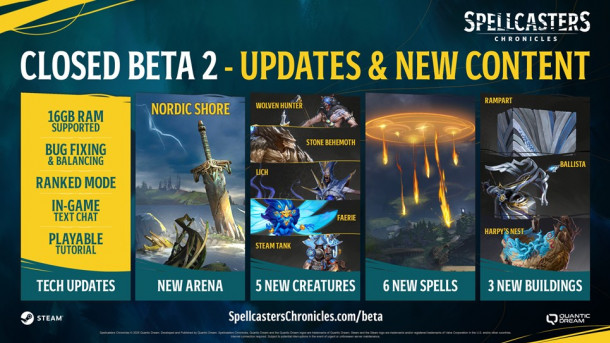
En esta segunda fase de pruebas también se expande el contenido jugable con:
La Costa nórdica de Valm: una nueva arena de 5 carriles que cuenta con líneas de visión abiertas, condiciones ambientales extremas un diseño distintivo.
Seis nuevos hechizos: los jugadores pueden incluir en sus mazos Lluvia de fuego (Fire Rain), Granada de veneno (Poison Grenade), Infusión de hielo (Ice Infusion), Infusión de fuego (Fire Infusion), Sacrificio (Sacrifice) y Resurrección ( Resurrection).
Cinco nuevas invocaciones: los jugadores pueden incluir en sus mazos a Stone Behemoth, Lich, Faery, Steam Tank y a Wolven Hunter.
Tres nuevos edificios: los jugadores pueden incluir en sus mazos el Nido de Arpías (Harpy’s Nest), el Baluarte (Rampart) y la Balista (Ballista).
Para obtener un desglose completo de los nuevos contenidos, los ajustes de equilibrio, las correcciones de errores, los problemas conocidos y las mejoras técnicas que llegan con la Beta Cerrada 2, los jugadores pueden consultar las notas del parche completas, disponibles junto con el lanzamiento de esta fase de pruebas.

Consulta las notas del parche de la Segunda Beta Cerrada aquí:
La Beta Cerrada 2 introduce la Costa nórdica de Valm, la segunda arena jugable desde la presentación de Spellcasters Chronicles. Ambientada en una costa escarpada marcada por un antiguo enfrentamiento entre las fuerzas de Valmide y criaturas de los reinos exteriores, la Costa nórdica se extiende sobre los restos de una guerra olvidada: desde barcos destrozados y armas colosales hasta los restos de bestias abisales esparcidos por los acantilados.
Construida en torno a un diseño único de cinco carriles, la arena favorece los enfrentamientos a ras de suelo, mientras que cuevas serpenteantes, senderos estrechos y rutas costeras ofrecen múltiples oportunidades para flanqueos, retiradas y emboscadas.
CONSTRUYENDO UN CAMPO DE BATALLA MÁS FLUIDO PARA EL SEGUNDO FIN DE SEMANA DE LA BETA CERRADA
Además, esta segunda fase de la beta hace énfasis en el rendimiento, el uso de la memoria y la estabilidad general del juego, al tiempo que amplía la disponibilidad de los servidores con la incorporación de Asia junto a los ya existentes de Europa y Norteamérica. Como resultado de estas optimizaciones y mejoras de infraestructura, los requisitos del sistema también se han actualizado para la Beta Cerrada 2 con el fin de ofrecer una experiencia más fluida en una gama más amplia de configuraciones de hardware:
Requisitos mínimos del sistema
CPU: Intel Core i5-10400 o AMD Ryzen 5 2600 o equivalente (6 núcleos / 12 hilos).
GPU: NVIDIA GeForce RTX 2070 o Radeon RX 5700 o equivalente con al menos 8 GB de VRAM.
Memoria/RAM: 16 GB de RAM.
Almacenamiento: SSD NVMe.
Sistema operativo: Windows 11.
Requisitos del sistema recomendados
CPU: Intel Core i7-10700K o AMD Ryzen 7 2700 o equivalente (8 núcleos / 16 hilos).
GPU: NVIDIA GeForce RTX 3070 o Radeon RX 9060 XT o equivalente con al menos 10 GB de VRAM.
Memoria/RAM: 16 GB de RAM.
Almacenamiento: SSD NVMe.
Sistema operativo: Windows 11.
Los jugadores que deseen unirse a la Beta Cerrada pueden registrarse directamente a través de la página de Steam de Spellcasters Chronicles o mediante el sitio web oficial durante el fin de semana. El soporte técnico estará disponible durante toda la prueba en el servidor oficial de Discord del juego, donde los jugadores también podrán obtener directamente claves para la Beta Cerrada a través de funciones comunitarias dedicadas.
El Acceso Anticipado de Spellcasters Chronicles comenzará el 26 de febrero de 2026, con nuevos contenidos que incluyen nuevos hechizos, nuevas invocaciones y más.
Las Ediciones de Fundador, que incluyen una clave para la Beta Cerrada, títulos, estandartes y aspectos de personaje exclusivos, están disponibles en la página de Steam de Spellcasters Chronicles; se desbloquearán permanentemente en el Acceso Anticipado y estarán disponibles temporalmente durante la Beta Cerrada II.
Quantic Dream es un estudio de desarrollo de videojuegos fundado en 1997 por David Cage, con sedes en París (Francia) y Montreal (Canadá). Las experiencias únicas ofrecidas por Heavy Rain™, Beyond: Two Souls™ y Detroit: Become Human™ han conmovido a millones de jugadores en todo el mundo y han ganado más de 250 premios internacionales, contribuyendo significativamente al reconocimiento de la narrativa interactiva en los videojuegos.
Desde 2019, Quantic Dream es su propia editora, habiendo lanzado en PC los títulos de su catálogo histórico: Fahrenheit™ (Indigo Prophecy), Heavy Rain™, Beyond: Two Souls™ y Detroit: Become Human™. En 2022, Quantic Dream se unió a NetEase Games para potenciar su visión creativa y acelerar el desarrollo de títulos que redefinen la experiencia interactiva para jugadores de todo el mundo.
En 2025, Quantic Dream anunció Spellcasters Chronicles, su primer título original multijugador y un audaz paso creativo hacia el género de acción y estrategia. Esto brinda al estudio la oportunidad de explorar nuevos territorios creativos manteniéndose fiel a su legado de innovación narrativa.
Utilizamos cookies propias y de terceros para garantizar el funcionamiento de la web, medir su uso y mejorar nuestros servicios. Puede aceptar todas las cookies, rechazar las no necesarias o configurar sus preferencias. Política de cookies
Configurar cookies
Necesarias para que la web funcione correctamente. No se pueden desactivar desde este panel.
Ayudan a medir el uso del sitio y mejorar sus contenidos.
Permiten publicidad, medición de campañas o personalización de anuncios.
Guardan preferencias o permiten contenido externo no necesario.